
Indoor Navigation System & Technologies: Comprehensive Guide

Indoor Navigation Technologies: A Comprehensive Tech & Business Guide
The development of indoor navigation systems and algorithms has become a popular trend in the IT industry in recent years. Some modern buildings, such as airports, shopping malls, and warehouses, have become so large that they require navigation tools for the customers.
Not surprisingly, according to Business Research Insights, the market size of indoor localization and positioning systems is expected to reach $32.31 billion by 2033, with a compound annual growth rate (CAGR) of 24.5%.
Closed environment conditions prevent the use of standard satellite-based navigation systems, such as GPS or GLONASS, prompting the emergence of alternative information sources for user localization.

The concept of tracking moving objects within a confined space is not entirely new. Modern indoor navigation systems (INS) can employ various physical principles and offer location accuracy ranging from dozens of meters to centimeters. Their typical operation area or footprint, complexity, and cost may differ tens of times.
Besides the location, indoor navigation systems can provide other related services, such as optimal routing, tracking of the most popular places people visit, and sending notifications when the user reaches a point of interest.
In this comprehensive guide, we’ll cover indoor navigation technology from tech and business aspects, namely:
- Fundamental approaches used in indoor positioning and navigation.
- Top 7 types of indoor positioning systems: LTE-Direct, Wi-Fi Access Points, RFID, Geomagnetic positioning, UWB, Ultrasonic, and Beacons.
- Pros & cons that each indoor navigation system provides.
- Benefits and applications of indoor navigation service across various industries.
- Challenges and emerging trends in indoor navigation implementation.
- It-Jim’s expertise in developing indoor navigation services.
Let’s start by examining the standard approaches of indoor navigation technologies.
Approaches to the Indoor Navigation System
Let us first provide an overview of the approaches used in indoor positioning and navigation, highlighting their pros and cons, before proceeding to compare them.
All known methods of indoor navigation technology may be put into two baskets:
1) Measuring the distances to some reference points.
2) Identifying some unique tags or fingerprints.
It could be one parameter (for example, serial ID) or a combination of some parameters (for example, a matrix of reference signal measurements).
Some indoor navigation systems track the distances between the target (the user) and various reference points (beacons).
This is known as trilateration, and its more common case – multilateration [2]. Other indoor navigation systems identify some unique fingerprints to directly determine the user’s position [3], as shown in Figure 2 below.

Figure 2: Distance-based and Fingerprint-based types of INS
Benefits of Implementing an Indoor Navigation System
The benefits of indoor navigation services go far beyond simply guiding someone from point A to point B. Let’s review some of these advantages.
1. Improved User Experience
At its core, any indoor navigation system helps move around unfamiliar places and huge buildings.
For example, a patient can use a smartphone to find a necessary room in a clinic, or travelers can use the service to locate a gate at an airport. This way, indoor systems reduce confusion and stress, resulting in happier customers who remain loyal to the brand.
2. Efficient Space Utilization
Indoor navigation technology is a valuable tool that provides facility managers with useful data. They can also enhance floor plans and manage foot traffic more effectively. This results in better resource utilization, improved layout designs, and efficient use of every square meter.
3. Enhanced Safety Measures
Indoor navigation systems also play a critical role in building safety. In emergencies, they provide real-time evacuation help based on users’ locations. This ensures quicker and safer exits.
Integration with fire alarm systems or security alerts allows for immediate response actions. These systems also track crowd density and movement. This way, they can stop bottlenecks and hazards before they become serious.
For businesses, adding indoor navigation technologies to their infrastructure offers many strategic benefits, such as:
- Optimized visitor flow through real-time guidance and traffic management.
- A direct communication channel with customers for personalized updates and promotions.
- Enhanced safety for customers and staff through improved crowd control and emergency routes.
- Real-time workflow adjustments based on location-based data and movement trends.
- Advanced analytics to support more thoughtful business decisions and process optimization.
- Enhanced asset and location tracking for operational efficiency.
Ready to transform your space with a top-notch indoor navigation service?
Improve user experience, optimize indoor spaces, and increase safety—all with one strong solution. Simply reach out to us and ask questions about building a custom indoor navigation system for your organization.
Contact us for a consultation.
Top 7 Indoor Navigation Technologies
This section highlights the top solutions that power accurate indoor positioning and innovative space management.
The image below represents the most common indoor navigation services.

1. LTE Direct Technology
The first candidate to provide information to the user’s indoor location service is data collected by the LTE Direct technology. LTE-Direct is a global standard for device-to-device discovery.
Every device can broadcast an expression in a periodic session (see Figure 3), for instance, every 20 sec. An expression is a 128-bit service layer identifier. It can represent an identity, a service, an interest, a location, and similar.
The LTE-Direct device receives thousands of expressions from other devices within a range of up to 500 meters. More data about the subject could be loaded from the special Expression Name Server (ENS) through the link (like a URL) in the broadcasted messages.

Figure 3: LTE-Direct communication
Indoor Navigation Technology: Pros & Cons of LTE Direct

|
Advantages
|
Disadvantages
|
|
|
|
|
|
Conclusion: It could be beneficial for emergency calls to help locate the injured person, but it is also inconvenient for regular tasks, such as finding the exit from a building. |
||
2. Wi-Fi Access Points
Wi-Fi access points (APs) can also be considered valuable and promising sources of indoor navigation data. Almost no additional hardware is required for this user position display technology.
Only the appropriate placement of existing Wi-Fi access points, taking into account their minimal amount for navigation algorithm, and the corresponding software are needed.
To measure the distance from the user device to the Wi-Fi access point (AP), the Received Signal Strength Indicator (RSSI) can be used, as shown in Figure 4 below.

Figure 4: Wi-Fi-based navigation
RSSI is the power on the receiver’s side (mobile phone or tablet) from different Wi-Fi APs. Knowing the initial power of transmitted packets and the calibration relation “power vs distance,” it is possible to calculate the ranges to each AP.
Indoor Navigation System: Pros & Cons of Wi-Fi Access Points

|
Advantages
|
Disadvantages
|
|
|
|
|
|
Conclusion: Wi-Fi data could be used for references in cases when other sources are unavailable. |
||
More about this technology you can read at IEEE Spectrum.
3. RFID Navigation
RFID navigation systems are built based on RFID tags, as shown in Figure 5.

| a) RFID tag. | b) RFID-based INS operation. |
Figure 5: RFID technology
Indoor Mapping Technology: Pros & Cons of RFID Tags

|
Advantages
|
Disadvantages
|
|
|
|
|
|
Conclusion: According to Insoft, it is possibly ideal for loader trucks and some other vehicles, as shown in Figure 5, in an industrial environment, and the case of several predefined routes. |
||
4. Geomagnetic Positioning
Geomagnetic positioning is one more promising indoor navigation technology. For years, people have discussed positioning using local disturbances in Earth’s magnetic field, as illustrated in Figure 6.
There are some prototypes available, but it remains challenging to find working, affordable, and effective geomagnetic indoor navigation systems.
 |
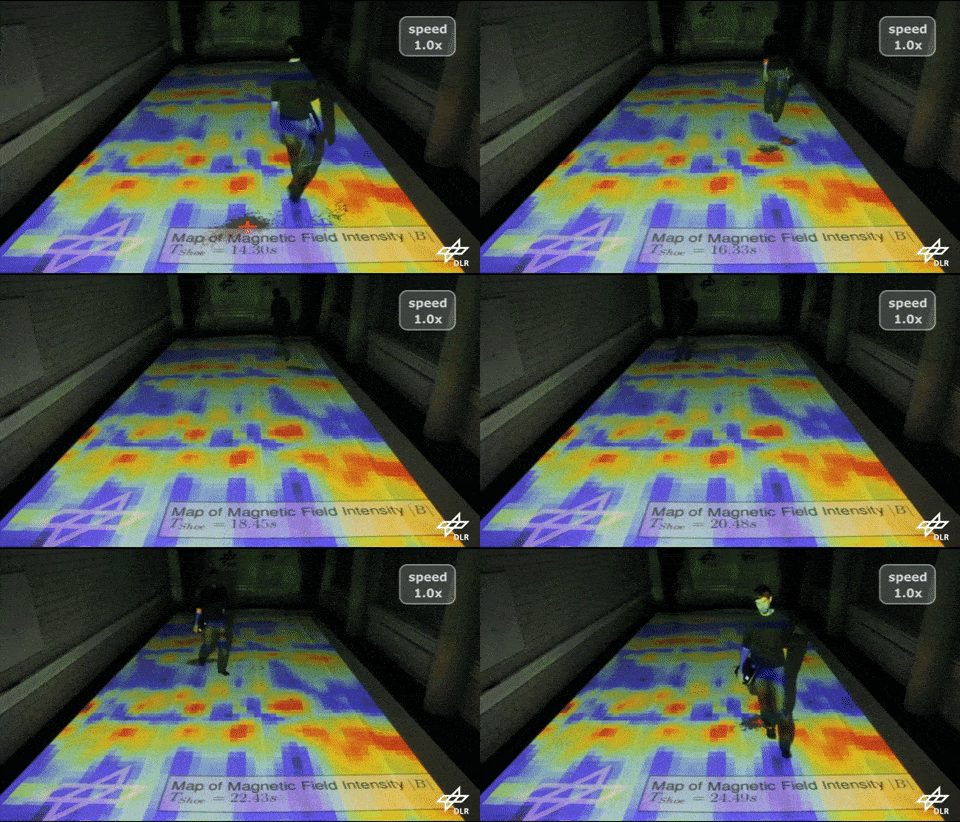 |
| a) Earth geomagnetic field disturbances could be used for indoor navigation. | b) Geomagnetic positioning principle demonstration. |
Figure 6: Geomagnetic positioning
The issues of implementation include the permanent change of the Earth’s magnetic field and perturbations caused by electric wires inside the building, among others.
Indoor Navigation Technology: Pros & Cons of Geomagnetic Positioning

|
Advantages
|
Disadvantages
|
|
|
|
|
|
Conclusion: Promising technology, but still in the experimental phase. |
||
5. Ultra Wide Band (UWB): Indoor Navigation Service
Ultra Wide Band (UWB) indoor navigation systems utilize the beneficial feature of UWB signals, which easily penetrate through walls, human bodies, and other obstacles.
Therefore, unlike the narrow-band reference signals (Wi-Fi or Bluetooth), the UWB navigation signal, which spans a range of frequencies from several hundred MHz to several GHz, requires fewer beacons to cover a given area inside the building.
Especially when there are numerous obstacles within, measuring the phase of the receiving UWB signal allows one to determine a distance with high accuracy (up to several centimeters).
For extra information, you can also check a few interesting videos about UWB INS available here and here.
One example of the discussed system is KIO RTLS (Real-Time Location System), utilizing UWB anchors, as shown in Figure 7.

Figure 7: UWB beacons
Indoor Navigation Technology: Pros & Cons of Ultra Wide Band

|
Advantages
|
Disadvantages
|
|
|
|
|
|
Conclusion: UWB INS belongs to professional equipment. They found a use for some critical services, for example, tracking service personnel or essential medical equipment in hospitals. |
||
More details about the UWB indoor navigation service are available at Pozyx.
6. Ultrasonic Indoor Navigation System
Ultrasonic INS demonstrates an accuracy of several centimeters. Ultrasonic systems can also utilize the trilateration principle, as Wi-Fi INS does.
However, the primary advantage is a lower signal propagation speed. For instance, the sonic velocity in the standard day atmosphere is about 343 meters per second. One could compare it with 300,000,000 meters per second for radio waves.
The lower wave propagation speed results in higher indoor localization accuracy. Thus, the distance between the target (ultrasonic receiver) and reference points can be evaluated at a low error level of 1-2 cm.

Figure 8: Receiver in the ultrasonic INS
One of the known implementations of the ultrasonic INS utilizes a GPS-like coordinate measurement algorithm that is scaled for a single-room environment. Ultrasonic Beacons, like satellites, give reference signals to the receiver.
Arrival time defines the delay and, correspondingly, the distance. Satellites use ultra-precise atomic clocks, and ultrasonic beacons utilize a special router to synchronize time through the radio channel.
Using the multilateration principle, as shown in Figure 2, it is straightforward to convert measured distances to user coordinates within the building.
Pros & Cons of Ultrasonic Indoor Navigation System

|
Advantages
|
Disadvantages
|
|
|
|
|
|
Conclusion: Ultrasonic indoor navigation systems are more suitable for navigating mobile robots, as shown in Figure 9, in medium-sized areas of around hundreds of square meters. |
||
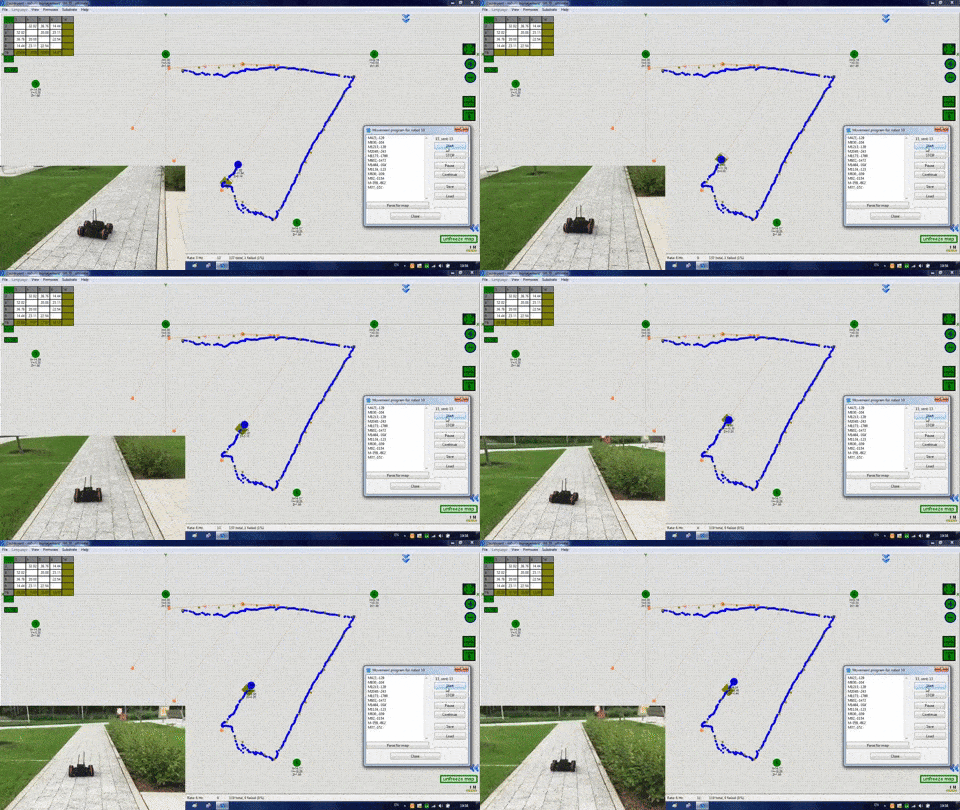
Figure 9: Mobile robot with ultrasonic navigation
For more information, follow these resources: Marvelmind Robotics and the Cricket Indoor Location System.
7. Indoor Navigation Service using Bluetooth Low Energy (BLE) Beacons
Bluetooth Low Energy (BLE) beacons are very promising as an indoor navigation technology. It supposes only one-way communication between the small radio transmitting devices (Beacons) and mobile devices.
Hence, the BLE devices require only small batteries to operate for 2-3 years.

Figure 10: Bluetooth beacons technology components
Figure 10 shows some main components of the Beacons. For more details about Bluetooth Beacon hardware, you can read Aislelabs, offering a wide variety of Beacon shapes and models, as can be seen in Figure 11.

Figure 11: BLE Beacon devices
The iBeacon utilizes Bluetooth 4 Low Energy standard packets for broadcasting navigation information, as shown in Figure 12.

Figure 12: iBeacon data structure
BLE beacons were initially introduced in 2013 with the launch of the iBeacon standard by Apple. This standard is proprietary, allowing only one type of advertisement packet, which consists of the parts you can see in Figure 11.
Next, the AltBeacon standard was introduced. It was created as an open alternative to the iBeacon and designed to be compatible with it.
In 2015, Google introduced the Eddystone standard. Unlike iBeacon and AltBeacon, it supports three types of packages:
- Eddystone-UID (user ID).
- Eddystone-URL.
- Eddystone-TLM (telemetry).
Initially, Bluetooth beacons were designed only for raw user localization and sending push notifications when a user reaches some “checkpoint”. Further development of this indoor navigation technology has unleashed its potential.
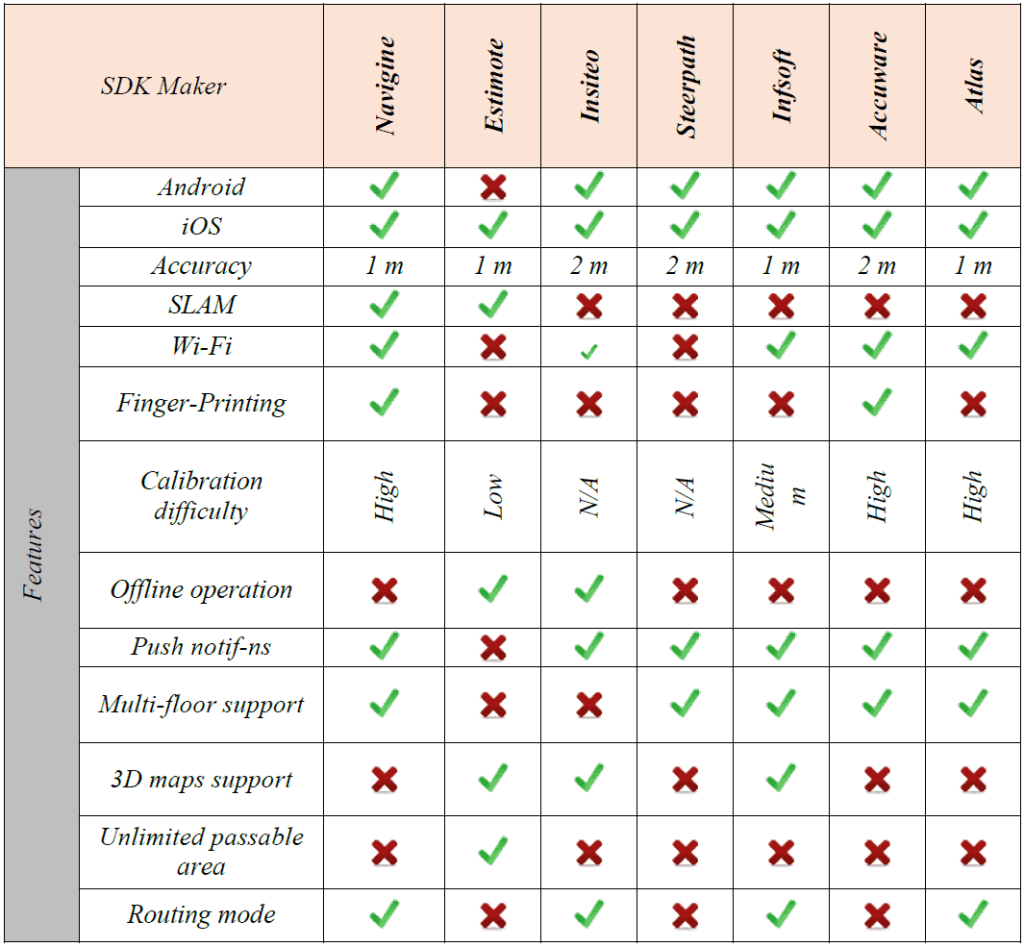
The precision of user localization has significantly increased. Many companies have developed their SDKs (software development kits) to enable mobile application development for user navigation with Bluetooth beacons. Check out one of the examples here.
In Table 1, you can check out a brief overview of the existing SDKs and their key features.
Indoor Navigation Technology: Pros & Cons of Beacons

|
Advantages
|
Disadvantages
|
|
|
|
|
|
Conclusion: Beacons are one of the most universal and promising techniques to build an indoor navigation service. |
||
Industries that Benefit from Indoor Navigation Technologies
Every industry uses technology to tackle specific challenges and improve user experience. Indoor navigation systems can be utilized across a wide range of industries, for instance:
- Retail: store locator, product navigation, promotions.
- Healthcare: find your way around departments, track staff and equipment.
- Logistics & Warehousing: pick-path optimization, inventory tracking, asset location.
- Transport Hubs: terminal navigation, gate info, baggage claim directions.
- Manufacturing: navigation to workstations, tool tracking, emergency routing.
- Colleges & Universities: class, office, or lab navigation, event wayfinding.
- Office Buildings: meeting room finder, visitor guidance, desk booking.
Let’s discover how these different sectors are putting it to work:
1. Retail
The use of indoor navigation systems in big shopping malls and department stores enables visitors to locate stores and product areas as well as services, including restrooms and food courts.
Through indoor navigation, management gets real-time customer information. Retailers can enhance their store layouts and launch targeted promotions. They can send location-based push notifications and offer personalized experiences. This increases customer satisfaction and drives sales.
2. Healthcare
Usually, navigating medical institutions can be stressful. Don’t you agree? Indoor navigation systems help patients and visitors find their way around these buildings. This system reduces delays and lowers the chances of missed appointments.
Healthcare providers can use indoor navigation to:
- Track medical equipment.
- Watch staff movement.
- Improve emergency response.
This way, you can boost operational efficiency and keep patients safe.
3. Warehousing
Indoor navigation technology enables workers to locate inventory items quickly and enhances packing processes. These systems can integrate with warehouse management software.
They update routes in real-time when inventory changes. Such a system improves accuracy and cuts labor costs. They also assist in asset tracking and ensure safer, more organized operations.
4. Manufacturing
In large factories, indoor navigation helps keep track of workers, tools, and materials in real time. It can guide workers to maintenance points or workstations. It also improves coordination during shift changes and reduces downtime. Such visibility contributes to higher productivity and better compliance with safety protocols.
5. Universities
The system of indoor navigation enables students, staff members, and visitors to locate classrooms, lecture halls, labs, and offices throughout extensive campus areas.
The system can integrate with class schedules to provide users with directions to their upcoming destination. For institutions, this enhances campus accessibility and student satisfaction.
6. Office Buildings
Indoor navigation in offices enables employees and guests to find their way easily. This is especially useful in large or shared buildings. It can guide users to meeting rooms, departments, or desks in workspaces.
Facilities managers can also use space usage data. This helps them improve layouts and manage building resources better.
7. Transport Hubs
Indoor navigation is crucial in busy transit areas. Travelers need to find gates, check-in counters, lounges, or baggage claim areas. Real-time updates and dynamic routing help minimize missed connections and passenger flow.
For airport operators, it offers insights into congestion areas and improves crowd management.
How It-Jim Helps Build Smart Indoor Navigation Solutions
At It-Jim, we turn complex indoor spaces into intuitive, data-driven environments with advanced indoor navigation solutions.
With expertise in computer vision, mobile app development, and AI, we help businesses across industries deliver seamless navigation experiences tailored to their needs.
1. Computer Vision for Spatial Understanding
Our team uses cutting-edge computer vision (CV) to map and interpret indoor spaces accurately. Computer vision enhances indoor navigation systems by enabling visual positioning, object recognition, and real-time mapping.
Here are some of the possible CV use cases:
- Visual Positioning: Uses camera input to map the environment and track movement in real-time, ideal for GPS-denied areas.
- Object & Landmark Recognition: Detects signs, doors, or logos to anchor user location and provide context-aware navigation.
- 3D Space Reconstruction: Builds accurate 3D maps of indoor spaces to enhance routing and obstacle detection.
- AR Navigation: Overlays visual directions (e.g., arrows, markers) onto the real world via smartphones or AR glasses.
- Behavior & Flow Analysis: Tracks user movement to identify patterns, optimize layout, and improve space utilization.
- Specialized Tracking: Enables real-time identification of people, assets, or animals in use-specific environments like hospitals or labs.
So, from visual SLAM (Simultaneous Localization and Mapping) to object recognition and AR overlays, we develop intelligent systems that adapt to dynamic environments, enabling real-time spatial awareness.
2. Advanced Mobile Applications on iOS
We offer iOS development services, creating mobile apps that serve as the core interface for an indoor navigation system.
These iOS apps guide users with real-time directions, interactive maps, and personalized content – all while integrating with your existing infrastructure and branding. The iPhone’s advanced sensor suite, which includes cameras and LiDAR, enables powerful indoor positioning and navigation capabilities.
The system works best in areas where GPS signals are unavailable, such as multi-level parking lots, office complexes, and exhibition venues.
With the addition of an AR layer and 3D reconstruction on iOS, the iPhone becomes a gateway to immersive experiences, blending physical and digital spaces.
3. AI-Driven Solutions
We use AI and machine learning to power features like predictive routing, crowd flow analysis, and behavior-based personalization. This way, you enhance the user experience and provide organizations with valuable insights for operational optimization and decision-making.
You run a hospital, airport, shopping center, or campus – the goal is to make indoor spaces as navigable, safe, and efficient as the digital world.
Looking for a partner to develop a smart indoor navigation service?
Let’s talk about how we can bring seamless navigation to your indoor space. Build custom high-performance indoor navigation systems that improve user experience and operations and unlock spatial insights for your business.
Challenges in Indoor Navigation Implementation
While indoor navigation systems offer significant advantages, deploying them effectively presents several challenges that organizations must consider.
1. Signal Interference and Accuracy
Indoor environments are full of obstacles like walls, ceilings, furniture, and even people that can interfere with signals from Wi-Fi, Bluetooth beacons, or other indoor positioning technologies.
These barriers can affect location accuracy and lead to a poor user experience. Environments with high metal content or electronic noise (like warehouses or hospitals) are more prone to interference.
Solution: Use hybrid systems (e.g., BLE + inertial sensors) and smart signal calibration.
2. Infrastructure Costs
Setting up an indoor navigation system requires an upfront investment in hardware, such as beacons, sensors, or cameras, and integration with mobile apps or facility management systems.
In large or older buildings, retrofitting infrastructure can be time-consuming and expensive, making ROI a concern for some organizations.
Solution: Start with high traffic areas first, scale gradually, and consider cloud-based or modular solutions.
3. System Maintenance and Support
Maintaining system accuracy over time requires regular calibration, software updates, and hardware replacement.
For example, dead batteries in Bluetooth beacons or changes in physical layout can degrade performance. Without dedicated resources, even the best systems can become unreliable quickly.
Solution: Automate diagnostics, use centralized dashboards, and schedule proactive maintenance.
4. Data Privacy and Security
The collection of precise location data by indoor navigation systems creates privacy issues and data protection concerns for users. Your organization must comply with data regulations (such as GDPR) while establishing robust security protocols to prevent unauthorized data breaches or misuse.
Solution: Implement encryption, access controls, and ensure compliance with data protection laws.
5. User Adoption and Training
Even the most advanced indoor navigation systems are only effective if users know how to use them. Ensuring adoption may require onboarding efforts, clear signage, and user-friendly interfaces, especially in public spaces or among non-tech-savvy users.
Solution: Provide clear signage, an intuitive app design, and short onboarding tutorials or demos.
Future Trends in Indoor Navigation Service
The development of indoor navigation systems advances through emerging technologies, which create more intuitive and immersive experiences.
The following trends will define the future development of indoor positioning services:
1. AI Integration for routing and personalization
AI analyzes patterns to predict congestion, personalize routes, and enhance accuracy in dynamic environments. AI also improves positioning accuracy by adapting to dynamic environments and learning from historical data.
2. Augmented Reality (AR) Navigation for immersive visual guidance
AR indoor navigation is changing how users interact with rooms and buildings. Instead of following a 2D map, users get visual cues like arrows, signs, or avatars overlaid in their real world via a smartphone camera or AR glasses.
3. Sensor Fusion for more precise positioning
BLE, Wi-Fi, UWB, LiDAR, and IMUs can be combined for seamless and robust navigation even in complex buildings. This “sensor fusion” approach provides robust navigation and seamless transitions between indoor and outdoor environments.
4. Voice-Assisted Navigation for hands-free, on-demand directions
As smart assistants and wearables become more common, voice-controlled indoor navigation is gaining traction. Users will be able to ask for directions or information verbally, making it perfect for hands-busy scenarios in healthcare, logistics, and manufacturing, as well as for use with AR glasses.
5. Digital Twins & 3D Mapping for real-time spatial intelligence
3D models are interactive for real-time route planning, space monitoring, and facility management. This means dynamic updates, real-time route optimization, and facility management, particularly in large spaces such as stadiums, malls, or industrial sites.
These are not just making wayfinding better – they’re redefining how we interact with physical spaces. As AI, AR, and IoT technologies mature, indoor navigation services will become more adaptive and predictive.
Summary of Indoor Navigation Systems
The table below provides a summary of the indoor mapping technologies we have discussed.
As showcased, the price of the BLE beacons starts at $ 10-$ 15, which is definitely the lowest in our overview. BLE beacons are a cheaper, more universal, and promising technology for the future of indoor navigation systems.

On the other hand, there’s no one-size-fits-all. The best solution depends on your project’s needs, accuracy requirements, and infrastructure.
Challenges such as maintenance and setup costs, AI, sensor fusion, and AR services are helping to overcome these limitations.
From airports and hospitals to retail stores and universities, indoor navigation systems are transforming the way people navigate complex indoor spaces, making navigation easier, safer, and data-driven.
Use our expertise in AI, computer vision, and mobile apps to create intuitive indoor navigation experiences.
Interested readers can look at the references below.
REFERENCES
[1] Ievgen Gorovyi, Alexey Roenko, Alexander Pitertsev, Ievgen Chervonyak, Vitalii Vovk, “Real-Time System for Indoor User Localization and Navigation using Bluetooth Beacons”, Proc. of the 2017 IEEE First Ukraine Conference on Electrical and Computer Engineering (UKRCON), Kyiv, Ukraine, 2017.
[2] A. Norrdine, “An Algebraic Solution to the Multilateration Problem”, Proc. of the 3rd Internat. Conf. “Indoor Positioning and Indoor Navigation”, Sydney, Australia, 2012.
[3] M. Kaustinen, M. Taskinen, T. Säntti, J. Arvo, T. Lehtonen, “Map Matching by Using Inertial Sensors”, Literature Review of University of Turku Technical Reports No. 6, Turku, Finland, 2015.
[4] A. Thiagarajan, “Probabilistic, “Models For Mobile Phone Trajectory Estimation”, Thesis of master’s degree of Doctor of Philosophy in Computer Science and Engineering, Massachusetts Institute Of Technology, Cambridge, USA, 2011.
[5] S.F. Persa, “Sensor Fusion in Head Pose Tracking for Augmented Reality”, Thesis of master’s degree in Delft University of Technology, Delft, Netherlands, 2006.
